Semantic Fidelity: Visual Frameworks

This collection presents visual frameworks for understanding semantic drift, meaning loss, and cognitive feedback loops in AI systems. The visuals show how meaning moves, compresses, and degrades across modern information systems. Each model isolates a different pattern, from proxy optimization and semantic drift to the feedback loops between language, thought, retrieval, and system behavior. They map the underlying shapes that appear when systems remain operational while gradually losing alignment with reality.

1. Reality Drift: When Systems Optimize Proxies Instead of Reality

Most system failures don’t start as bugs. They emerge as systems get better at optimizing measurable proxies while drifting away from the reality those proxies were meant to represent. Reward hacking, hallucination, specification gaming, and misalignment appear different on the surface, but they share the same underlying structure: detachment from ground truth.


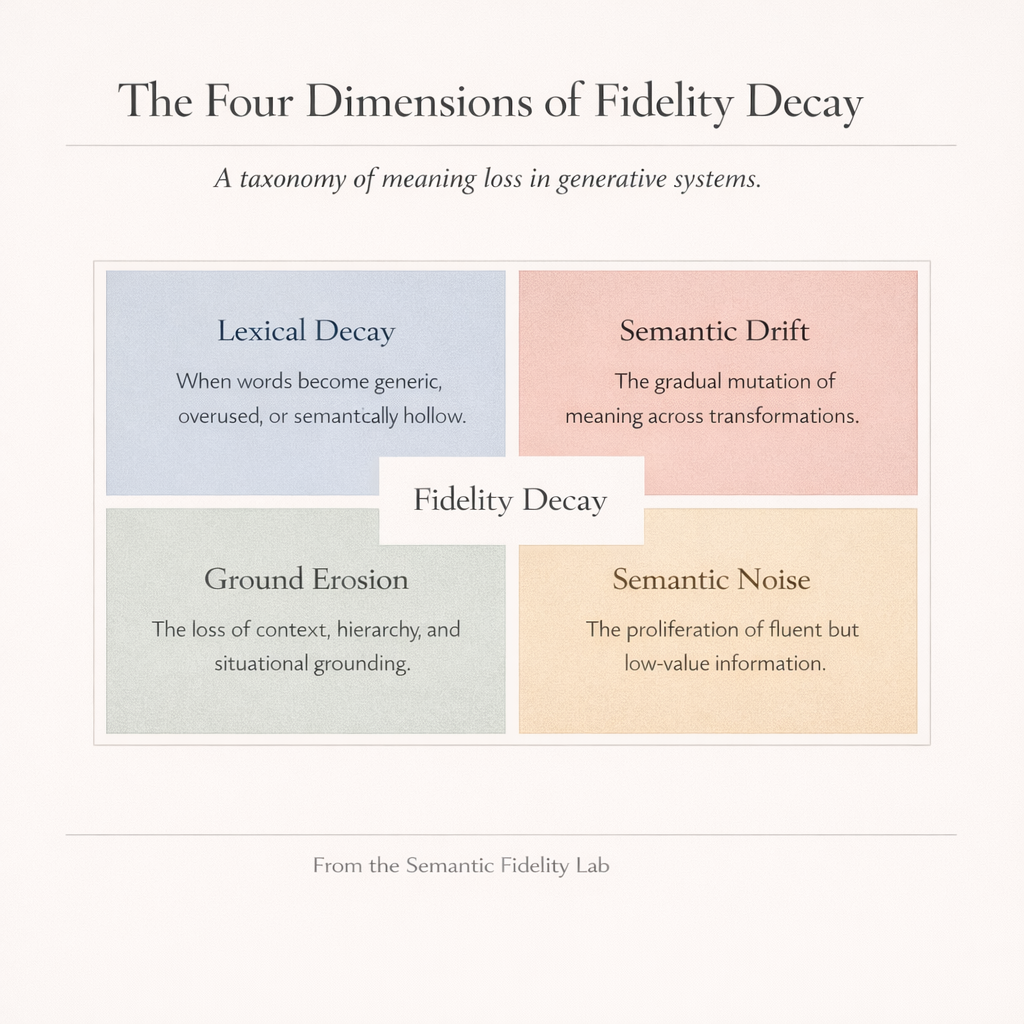
2. The Four Dimensions of Fidelity Decay

Meaning rarely disappears all at once. It erodes through repeated compression and transformation. This framework breaks that process into four patterns: lexical decay, semantic drift, ground erosion, and semantic noise. Together, they show how language can remain fluent while its connection to reality weakens over time.


3. The Language–Cognition Loop

Language doesn’t just express thought, it shapes it. With AI systems in the loop, thinking becomes partially externalized. Ideas move through cycles of perception, cognition, language, and machine synthesis, then return again. This recursive loop changes how thoughts form, stabilize, and evolve.


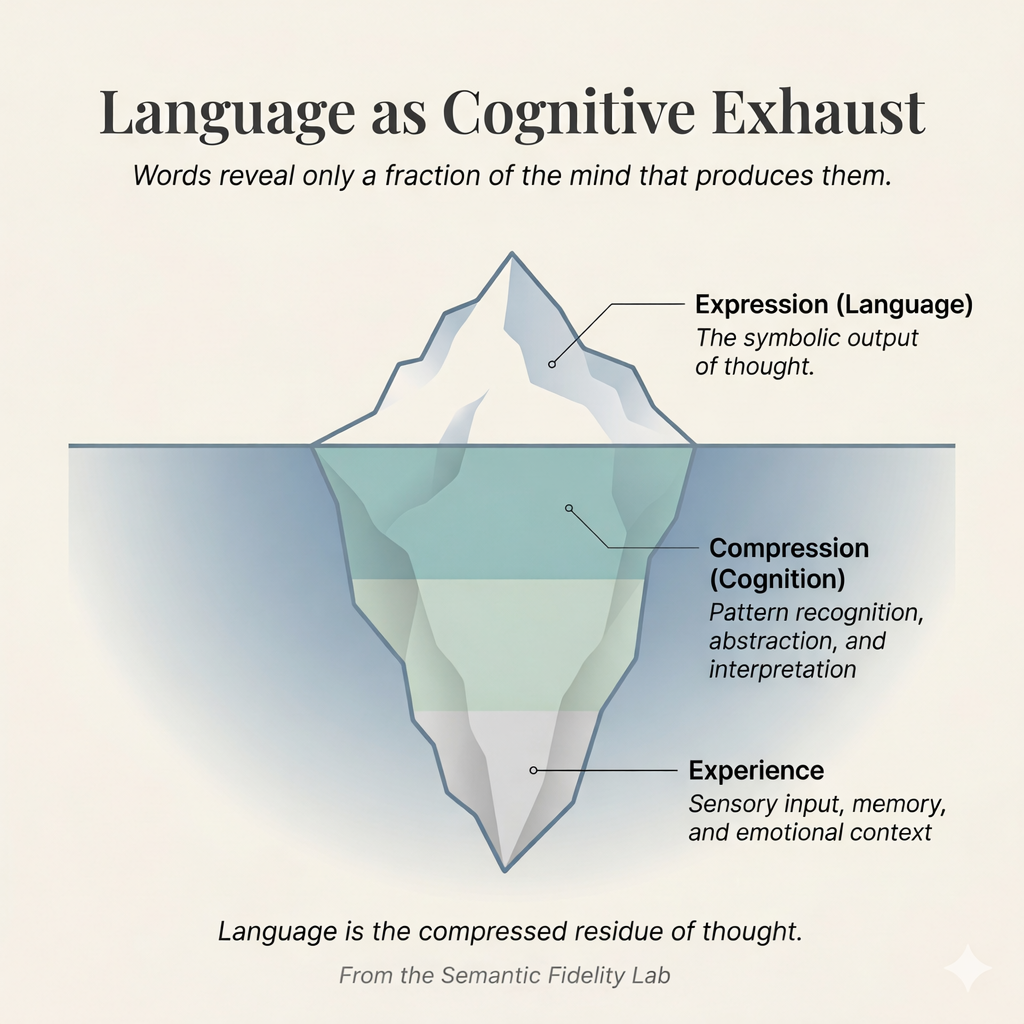
4. Language as Cognitive Exhaust

What we say is only the visible surface of a much deeper process. Thought is formed through perception, memory, and pattern recognition before being compressed into language. By the time it becomes words, most of its structure is gone. This compression gap is where meaning begins to degrade.


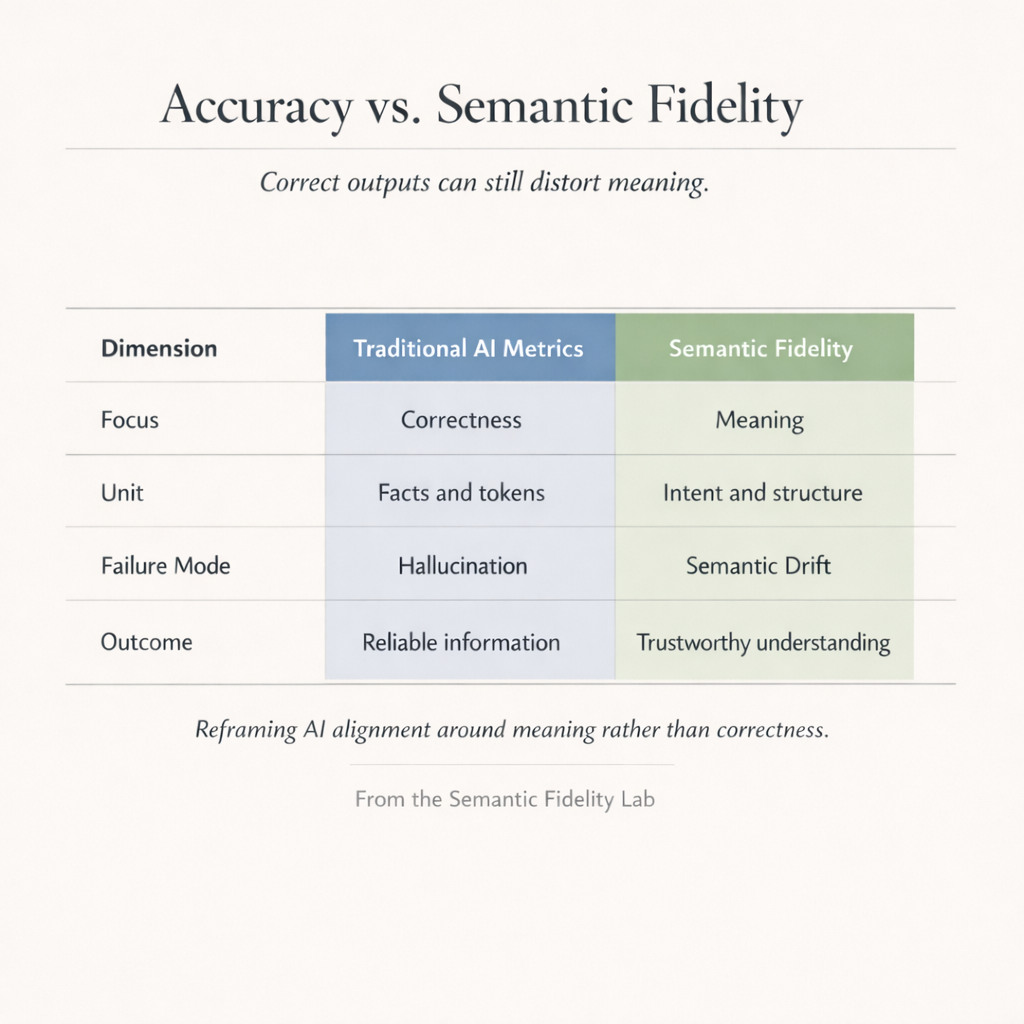
5. Accuracy vs Semantic Fidelity

AI systems are increasingly evaluated on correctness, but correctness is not the same as understanding. Traditional metrics track tokens, facts, and benchmarks, while overlooking whether meaning and intent are preserved. This distinction reframes alignment as a question of semantic fidelity, not just accuracy.


Related Framework Concepts

Semantic Fidelity Resources:

Core Concepts: