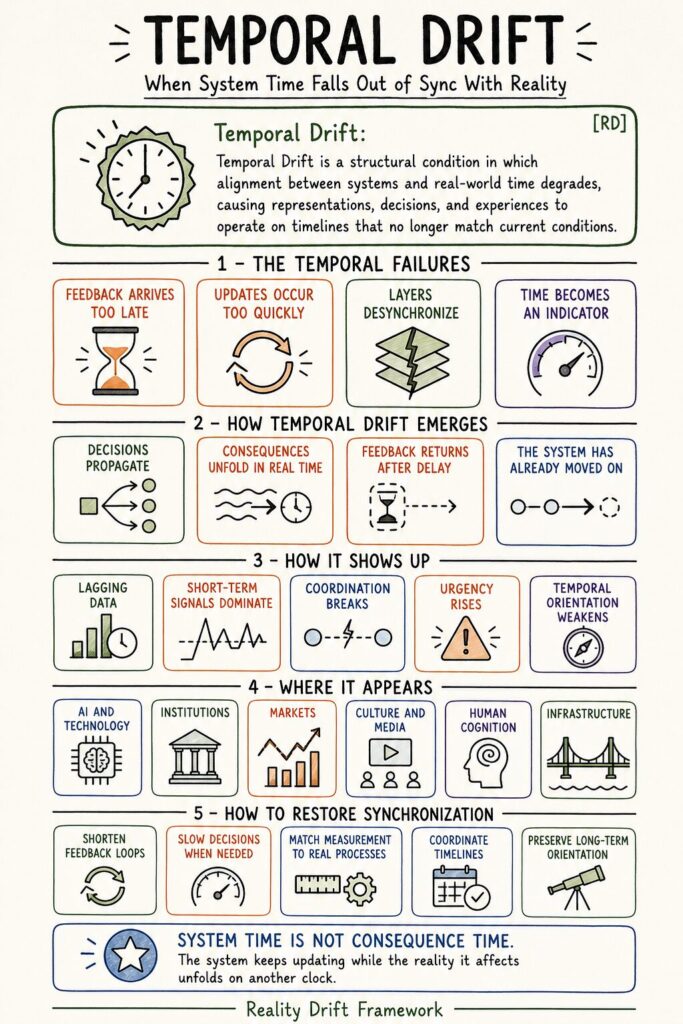
Temporal Drift (Definition)
Temporal Drift is the loss of alignment between system time and real-world time. Representations, decisions, and feedback loops continue operating but no longer match the timing of the conditions they track.
As systems accelerate, updates can outpace real change, feedback can arrive too late, and decisions can spread before their consequences become visible. Different layers begin operating on separate cadences, weakening the relationship between action, consequence, and correction. In everyday life, this can feel like compressed time, constant urgency, fragmented attention, and difficulty tracking what is current.
Download: Temporal Drift Concept Paper (PDF)