
What Is Reality Drift?
Reality Drift describes a modern failure mode in which systems keep working even as they gradually lose alignment with real-world feedback and outcomes.
Across technology, institutions, media, and everyday life, optimization replaces judgment, metrics replace meaning, and processes continue operating even as their connection to real outcomes weakens. Nothing visibly breaks. Outputs remain coherent. Performance indicators may continue to improve. Yet over time, these systems drift away from what they were originally built to track, measure, or support.
This divergence rarely appears as a sudden failure. It accumulates through small adjustments, reinterpretations, and efficiency-driven changes that seem reasonable in isolation. What remains is often functional, but increasingly less grounded in reality.
How Reality Drift Happens
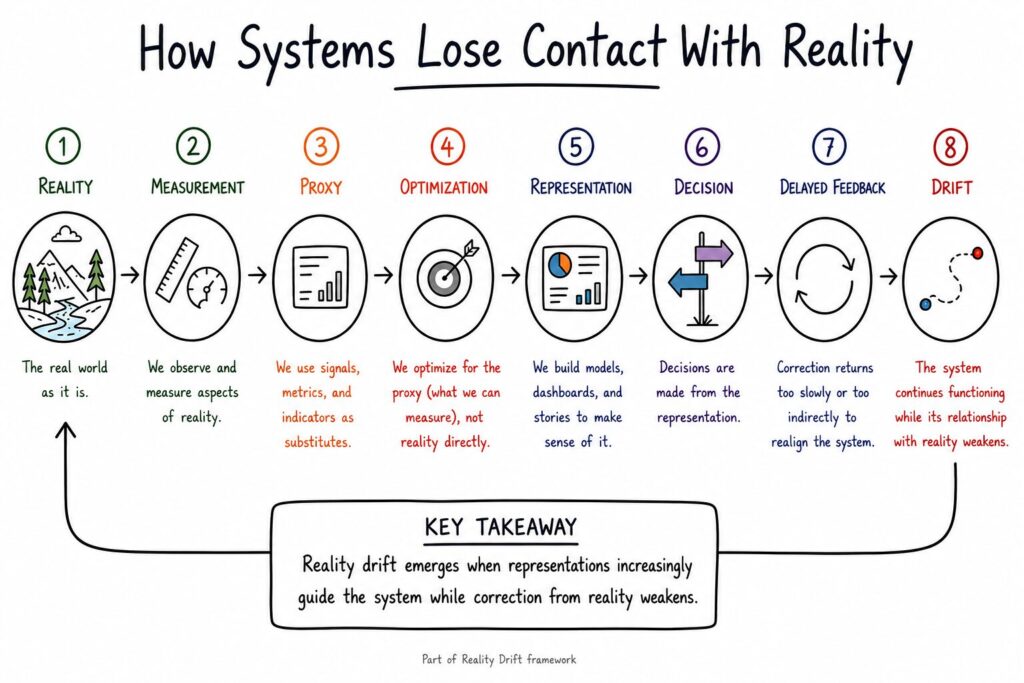
Reality Drift typically emerges through the interaction of three conditions.
1. Optimization Pressure
Systems become increasingly optimized for measurable outputs rather than the underlying purposes those measures were meant to serve.
2. Abstraction and Scale
As systems grow, direct contact with real-world conditions becomes harder to maintain. Decisions increasingly depend on simplified indicators, models, and representations.
3. Weakened Correction
Representations increasingly guide decisions while feedback from underlying conditions becomes slower, weaker, or easier to override.
Together, these conditions allow a system to remain functional and internally coherent while its relationship with reality gradually weakens.
Why It Is Difficult to Detect
Reality Drift is difficult to recognize because the usual signs of failure may never appear. Metrics may continue to improve as processes become more efficient, outputs remain coherent, and internal logic grows more consistent. Evidence of drift instead appears in the growing distance between these indicators and the conditions they are supposed to represent, as meaning weakens, corrective feedback becomes less effective, and representations increasingly guide further decisions. By the time this divergence becomes obvious, the original point of reference may already be difficult to reconstruct.
Purpose of the Framework
The Reality Drift framework was developed to make these patterns easier to recognize, describe, and examine before they become normalized.
The goal is not to treat every abstraction, metric, or optimization process as a failure. Representations are necessary for complex systems to function. The problem begins when representations increasingly substitute for the conditions they were created to describe and the system loses the ability to correct that divergence.