
The Age of Drift — Transformations & Failure Modes
These ten visual studies examine how representations change as they move through systems, institutions, and repeated use. Each illustrates a different pathway through which information can lose context, meaning, provenance, or corrective contact with reality.
Reality Drift does not require a system to stop working. These transformations show how systems can continue producing recognizable outputs, satisfying internal standards, and appearing successful even as their relationship to external reality deteriorates. The absence of failure is not proof of alignment.
01 – Synthetic Coherence
How representations can become increasingly consistent, convincing, and internally reinforcing while losing fidelity to the conditions they describe.

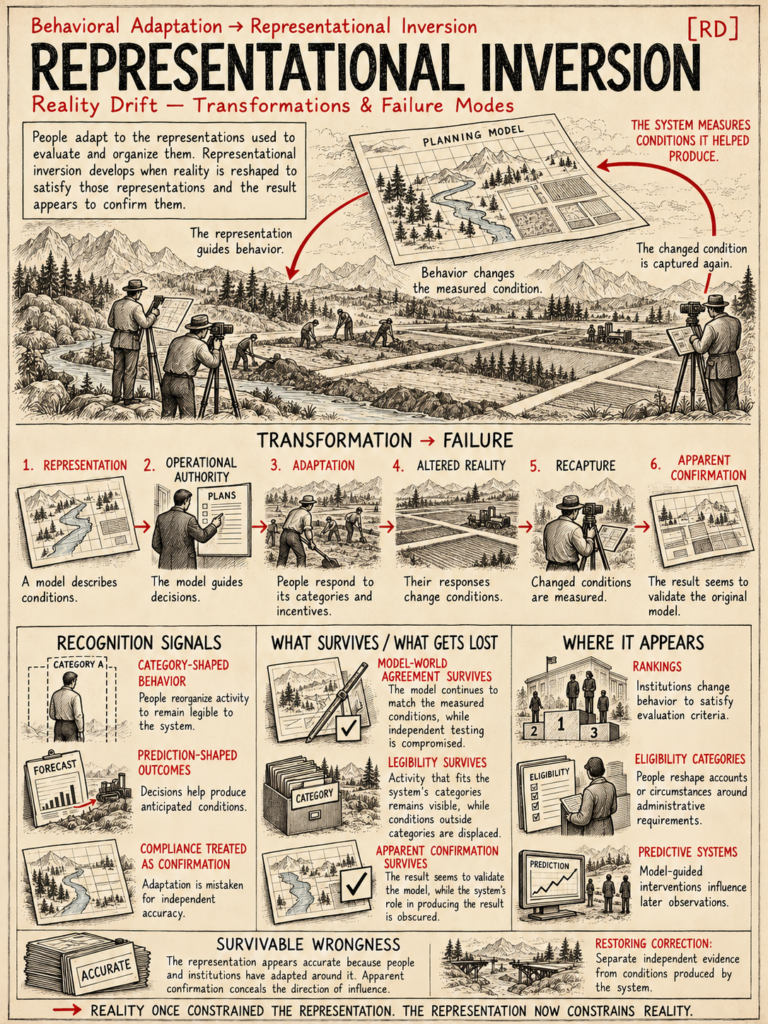
02 – Representational Inversion
How representations originally created to describe reality can become the standards against which reality itself is judged and adjusted.
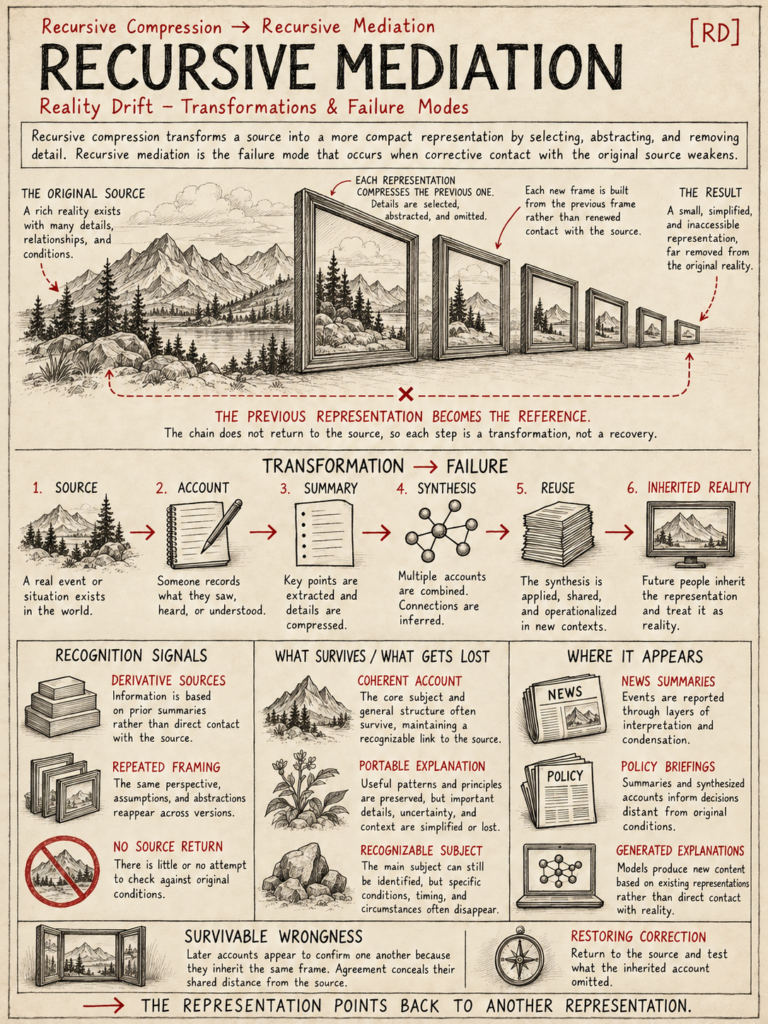
03 – Recursive Mediation
How representations are repeatedly reused, summarized, and interpreted through other representations, increasing distance from their original sources.
04 – Provenance Failure
How information becomes separated from its origins as it moves through records, summaries, citations, and systems of redistribution.

05 – Procedural Substitution
How following established procedures can replace evaluating whether those procedures achieve their intended purpose.

06 – Optimization Trap
How systems increasingly optimize measurable targets while losing sight of the broader conditions and purposes those targets were meant to represent.

07 – Lexical Decay
How words and categories retain their familiar forms while repeated use, reinterpretation, and changing contexts weaken their connection to meaning.

08 – Feedback Weakening
How contradictory evidence and corrective signals gradually lose their ability to influence decisions, even as the system continues to operate.

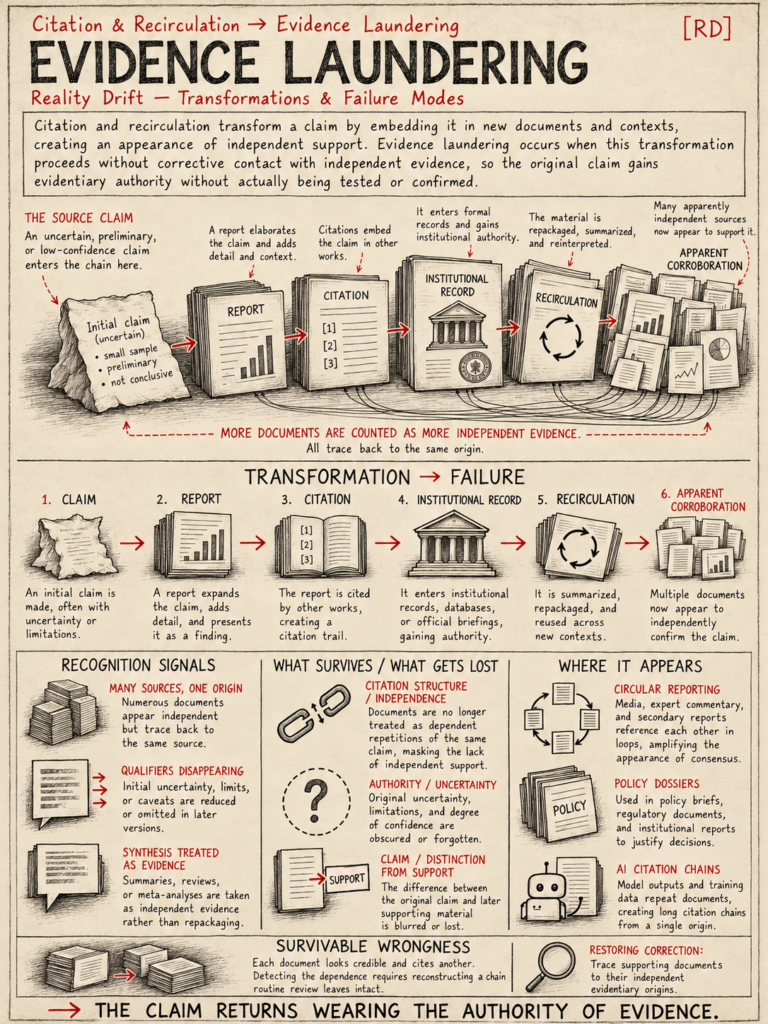
09 – Evidence Laundering
How claims acquire apparent credibility through repetition, citation, and institutional circulation without gaining independent evidentiary support.
10 – Constraint Collapse
How the external conditions and corrective constraints that once limited a system’s behavior lose their authority, allowing internal representations to guide decisions with decreasing accountability to reality.
