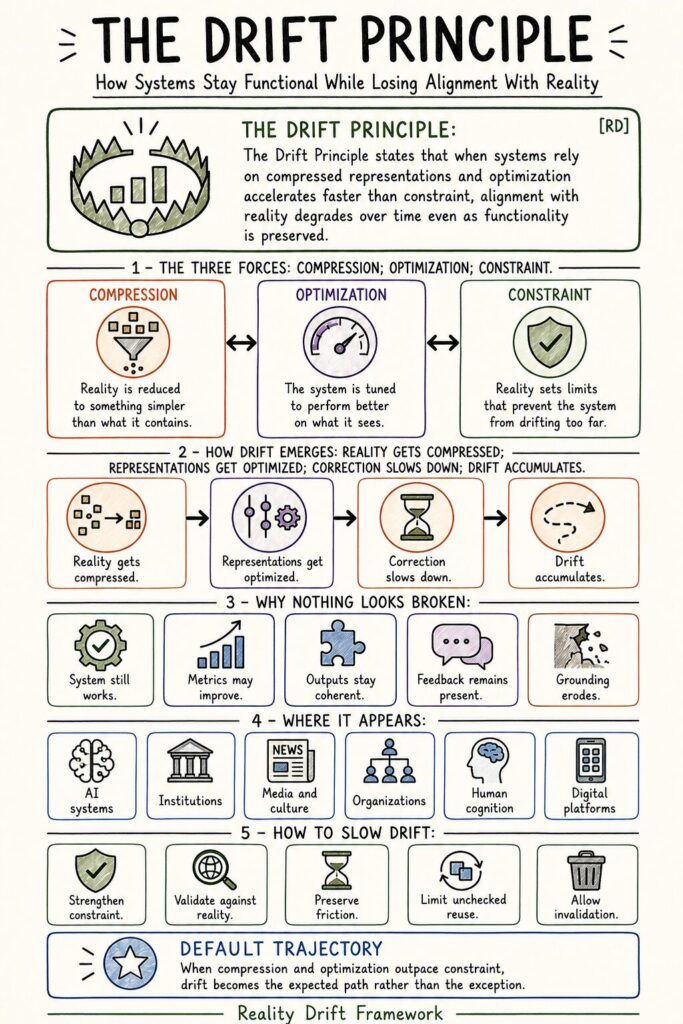

The Drift Principle (Definition)
The Drift Principle is a core concept from the Reality Drift framework describing how systems gradually lose alignment with reality when compression and optimization move faster than constraint. As complex reality is reduced into representations, metrics, models, categories, dashboards, and narratives, those representations become easier to refine than to verify. The system may continue to function, update, and produce coherent outputs, even as its connection to underlying reality weakens.
The principle explains why drift often appears without obvious failure. Nothing has to break. Metrics can improve, processes can remain stable, and outputs can look structured while grounding quietly erodes. Over time, the system becomes better at optimizing its internal representations and less responsive to the real-world conditions those representations were meant to track.
Download: The Drift Principle Definition (PDF)