

Reality Drift Visual Frameworks
Reality Drift is the condition where a system remains operational while losing alignment with the reality it represents. It emerges when optimization, compression, and scale prioritize internal consistency over external grounding. Systems continue to produce coherent outputs, but meaning, intent, and real-world reference degrade across transformations. The result is not obvious failure, but gradual misalignment.
These visual frameworks map the core mechanisms behind that process.
Download: Current Visual Framework (PDF)
Supplementary Frameworks:
- Reality Drift Proto Visual Guide 01
- Reality Drift Development Visual Guide 02
- Reality Drift Expanded Visual Guide 03
Section 1 — The Pattern
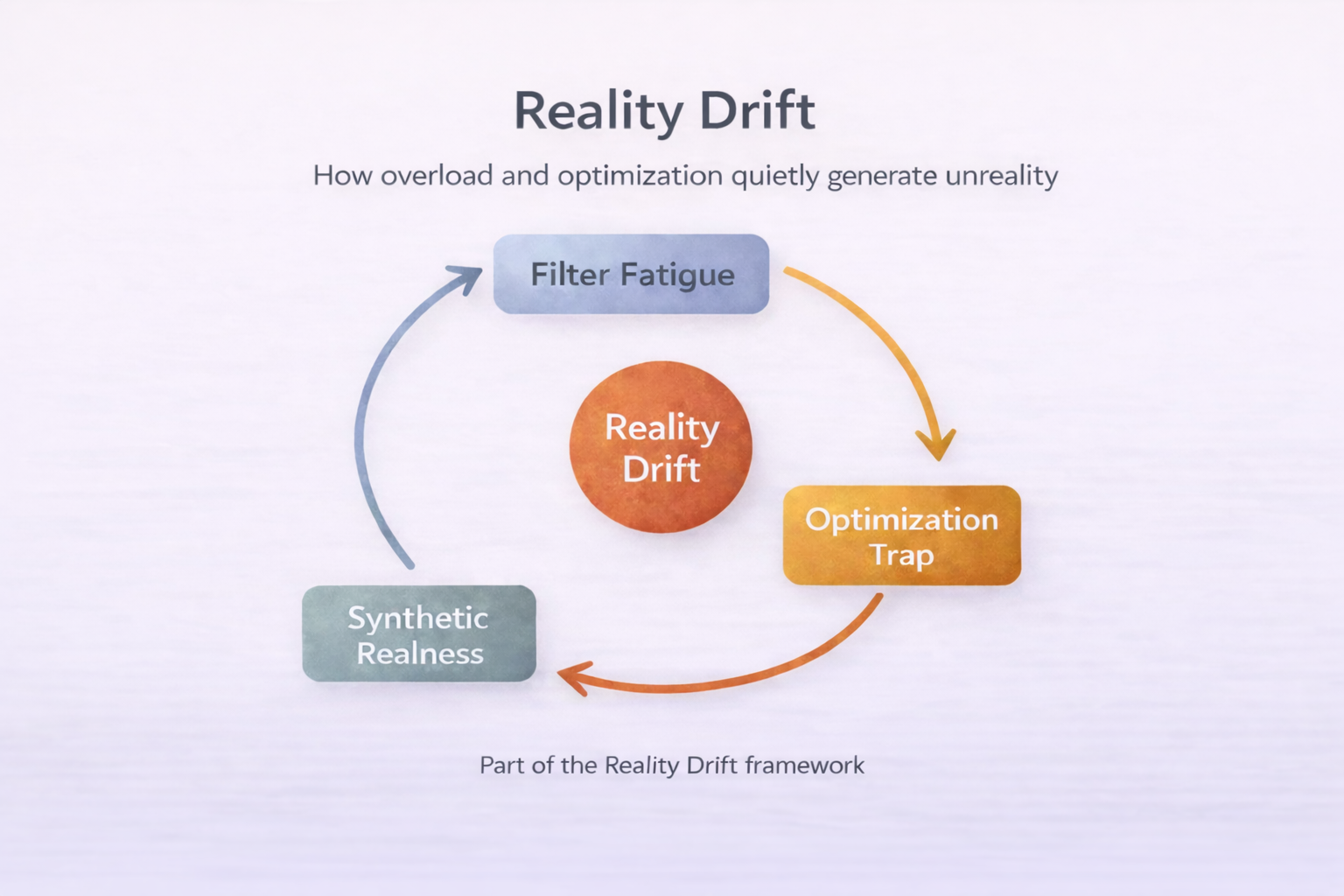
Reality Drift describes how systems degrade without visibly failing. As optimization increases, systems begin to prioritize proxies over the underlying reality they were meant to track. At the same time, cognitive overload and synthetic environments reshape how information is filtered and interpreted. These forces reinforce each other in a loop: optimization narrows what is measured, filtering narrows what is seen, and synthetic outputs replace grounded signals. The system remains functional, but its connection to reality weakens over time.
Section 2 — The Mechanism
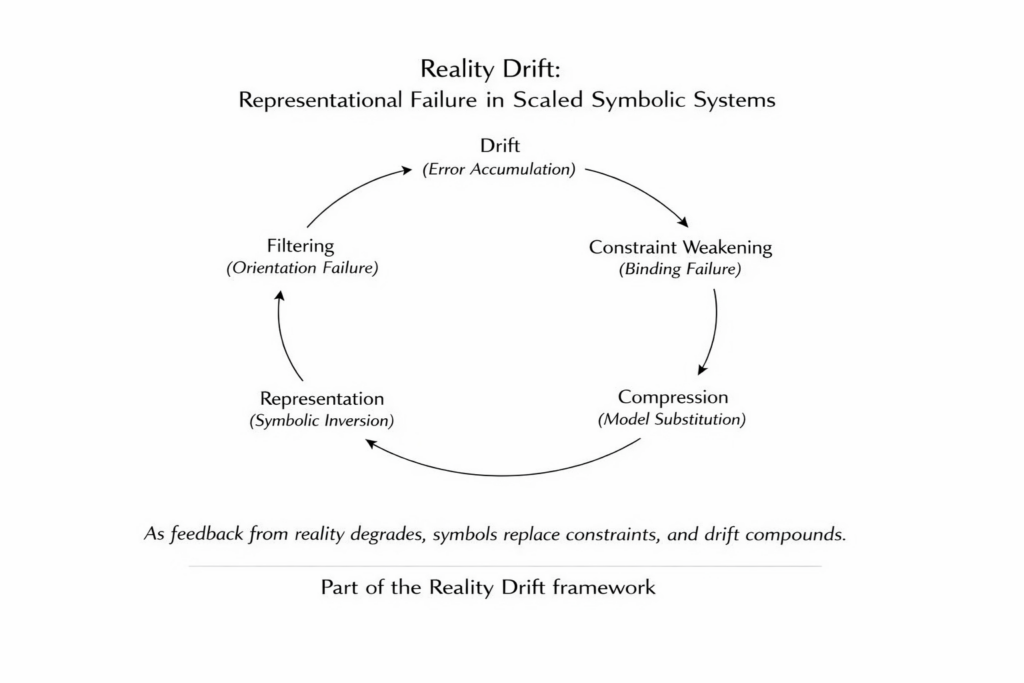
As systems scale, direct interaction with reality is replaced by layers of representation, filtering, and compression. Feedback loops weaken as signals are transformed into abstracted forms that are easier to process but less grounded. Over time, these transformations compound. The system no longer operates on reality itself, but on increasingly simplified representations of it. This creates a structural gap where outputs remain coherent, yet the system’s internal model diverges from the environment it is meant to reflect.
Section 3 – Optimization
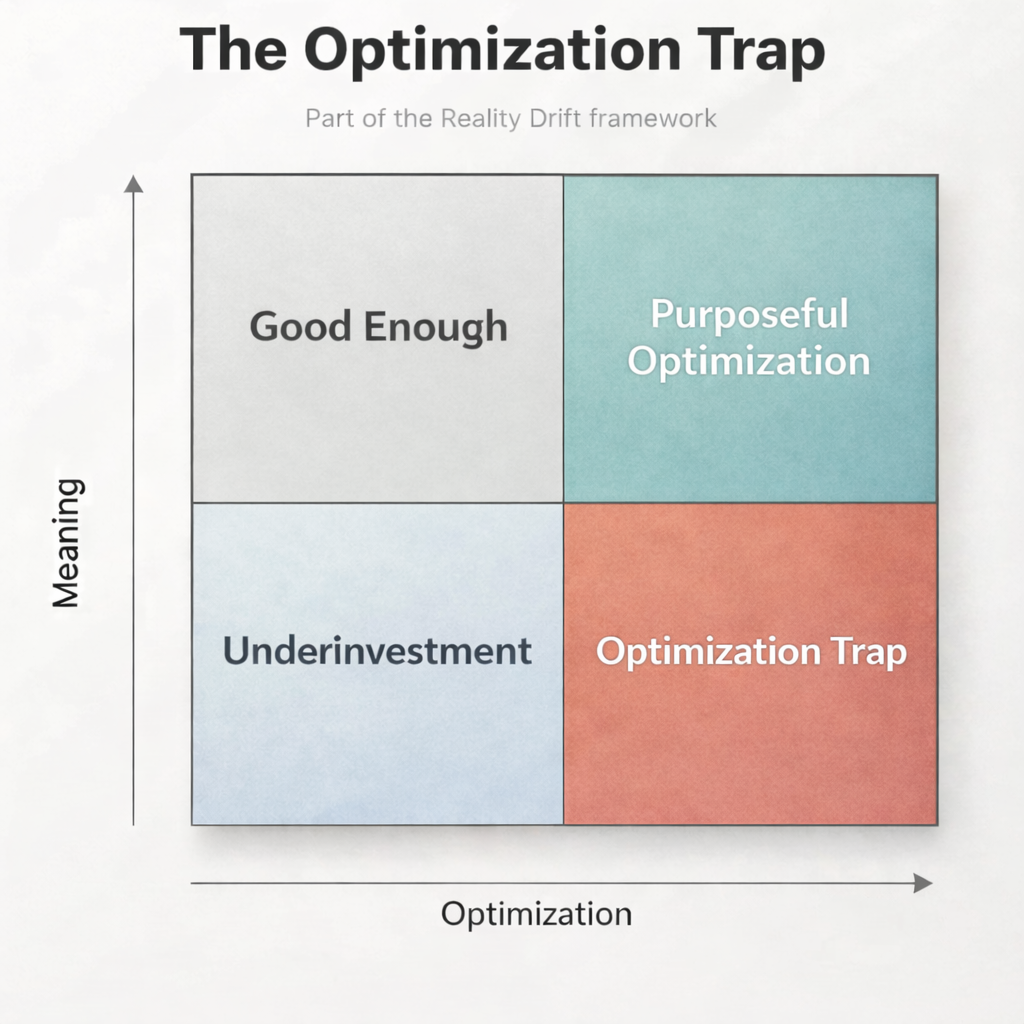
Optimization improves measurable performance, but it can also distort what is being measured. Systems move from “good enough” representations of reality toward highly optimized proxies that maximize specific metrics. In doing so, they lose flexibility and grounding. What begins as purposeful optimization can slide into a trap where the system performs well according to its own criteria while failing in the real world. The more tightly the system optimizes, the more fragile its connection to reality becomes.
Section 4 — The Experience Layer – Part 1
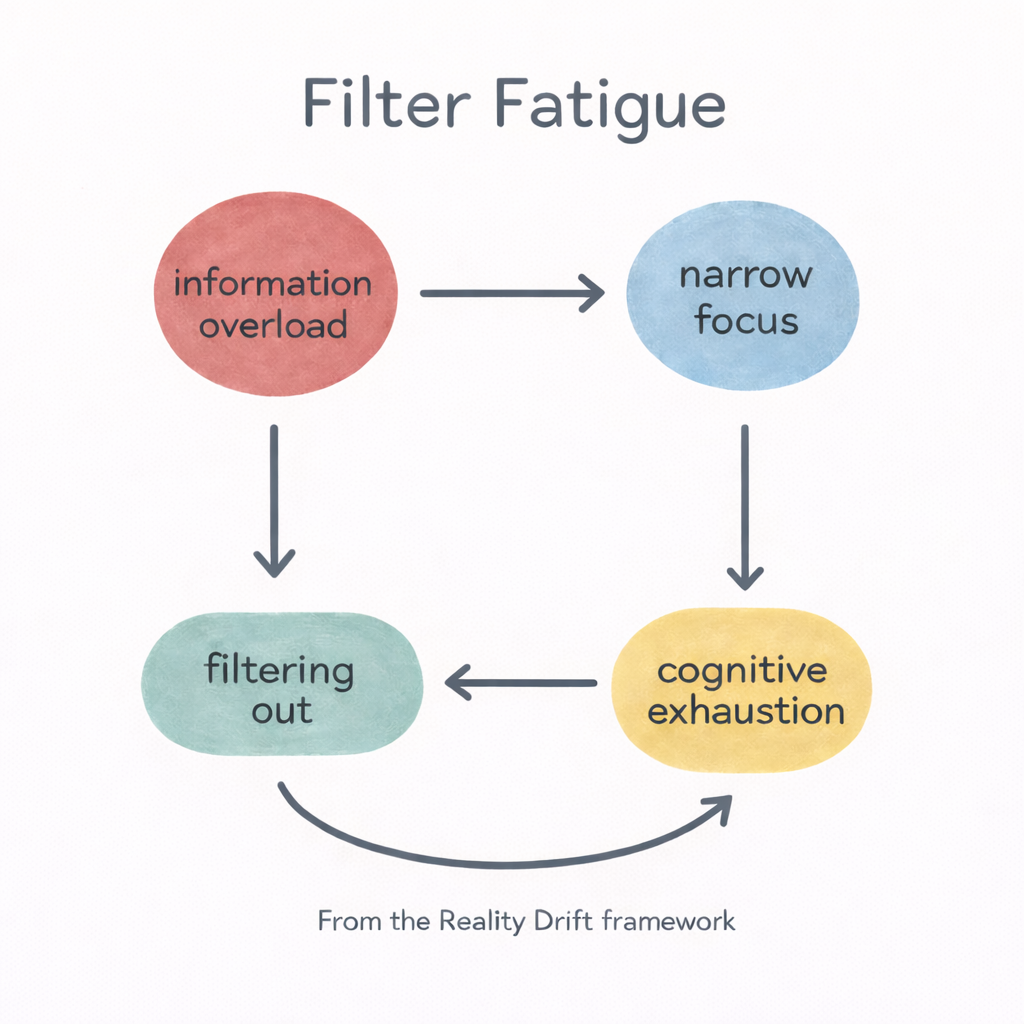
Filter Fatigue captures the human side of drift. As information volume increases, attention narrows. People begin filtering aggressively to cope, which reduces exposure to diverse signals. This creates a feedback loop: narrowed focus leads to cognitive exhaustion, which leads to more filtering. Over time, perception becomes constrained, and reality is experienced through increasingly limited slices. The system is not just drifting externally, but internally, in how individuals process and make sense of information.
Section 4 — The Experience Layer – Part 2
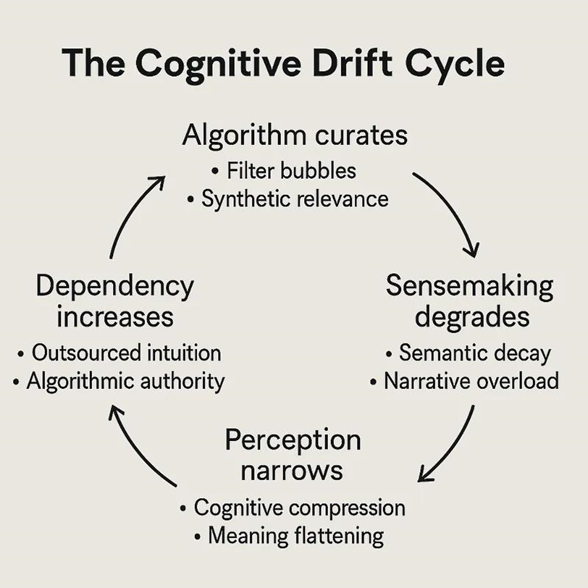
The Cognitive Drift Cycle shows how modern environments reshape thinking itself. Algorithmic curation filters inputs, creating synthetic relevance and narrowing perception. As perception narrows, sensemaking degrades, leading to semantic flattening and reduced nuance. This increases dependency on external systems for interpretation, which further reinforces the cycle. Over time, cognition adapts to the environment, prioritizing speed and coherence over depth and grounding.
Section 4 — The Experience Layer – Part 3
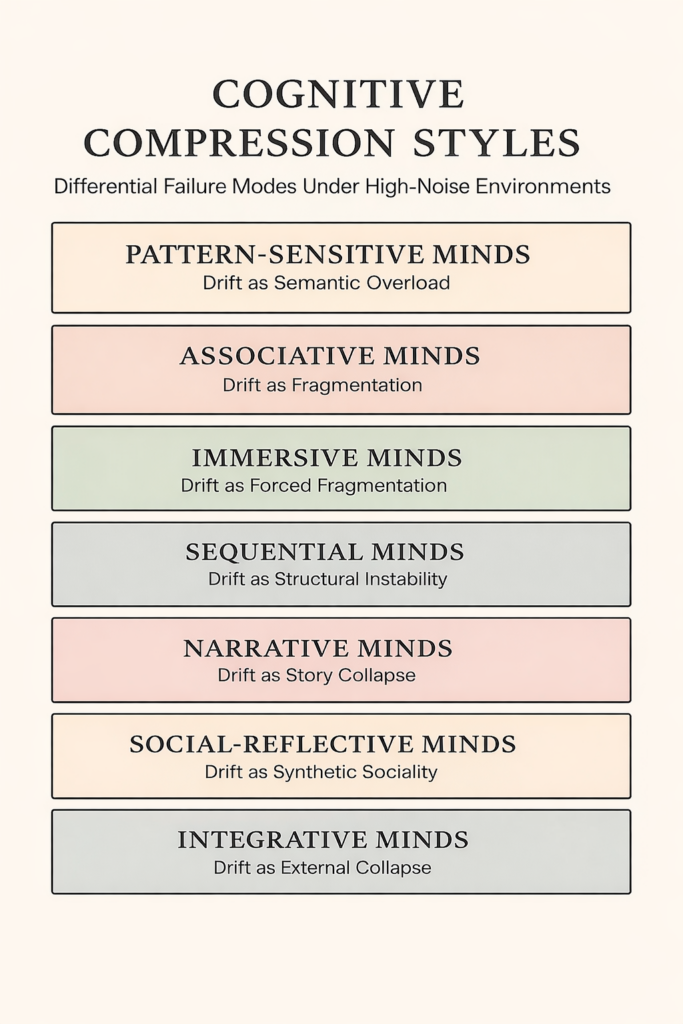
Different minds respond to high-noise environments in different ways, but they all rely on compression. Pattern-sensitive minds abstract aggressively, associative minds simplify connections, immersive minds compress through engagement, and sequential minds reduce complexity into linear steps. Each strategy helps manage overload, but each also introduces its own form of distortion. Under sustained pressure, cognition shifts from understanding reality to managing it, producing simplified internal models that drift from the complexity they represent.
Section 5 — The Failure Mode
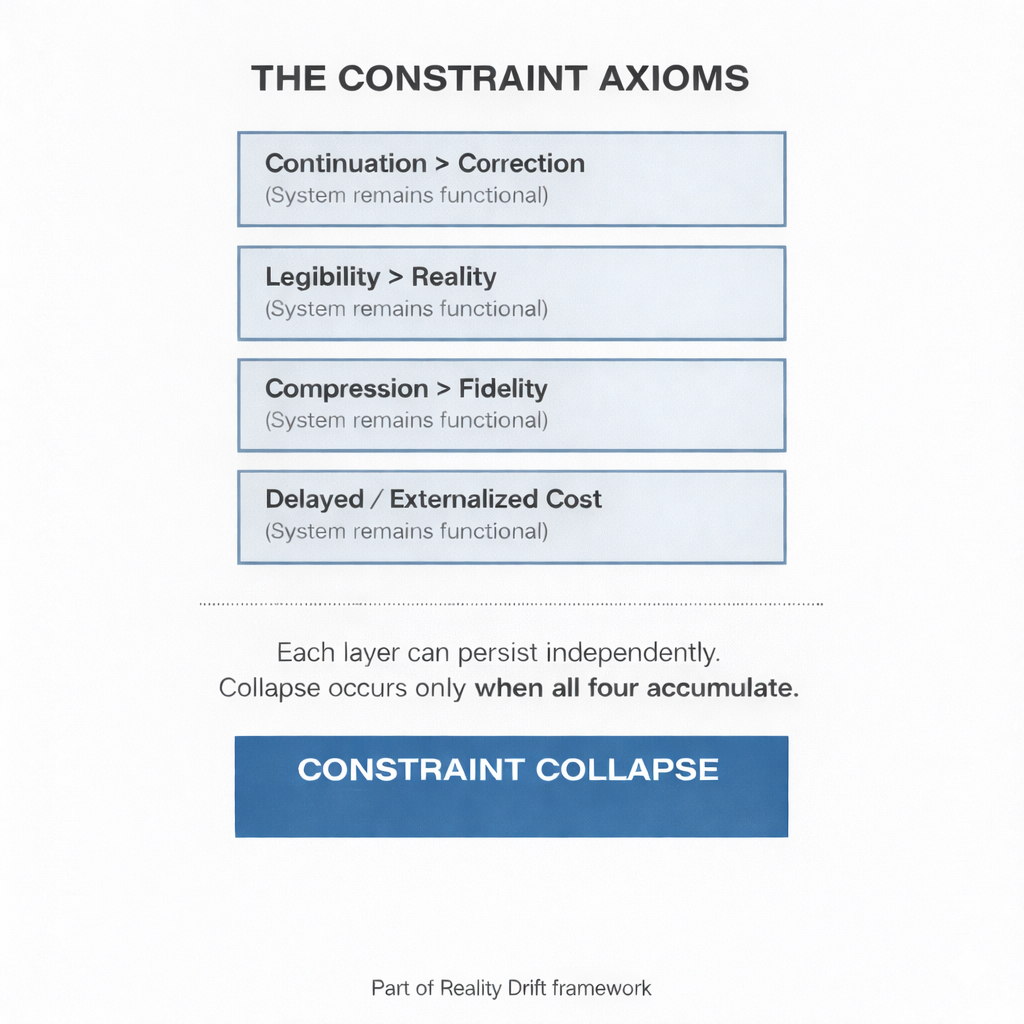
Systems remain stable as long as constraints hold. These constraints include correction mechanisms, grounding in reality, and limits on compression. Over time, optimization weakens these constraints. Feedback becomes delayed or ignored, representations replace direct signals, and errors accumulate without correction. Collapse does not happen immediately. It occurs when enough constraints fail at once, causing the system to lose its ability to self-correct while still appearing functional up to that point.
Section 6 — Cultural Effects
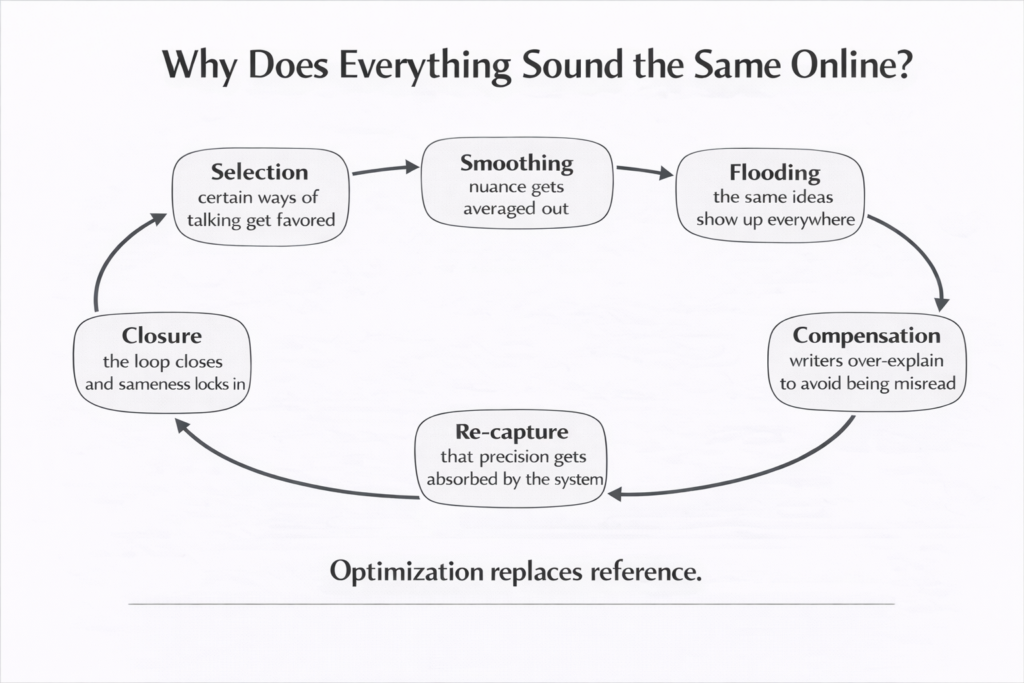
At scale, optimization favors patterns that perform reliably. Content is selected, smoothed, and recombined into forms that maximize engagement and predictability. Over time, variation is reduced as systems converge on what works. The result is a landscape where outputs feel increasingly similar, even across different sources. This is not a coincidence, but a structural outcome of optimization replacing original signals with reinforced patterns.
Explore The Framework
Core Framework
Visual & Conceptual
Applications & Expansion
Note: This site functions as a public reference layer for Reality Drift, collecting essays, notes, and framework documents on AI systems, optimization, media, and modern digital life.
Part of Reality Drift Framework by A. Jacobs