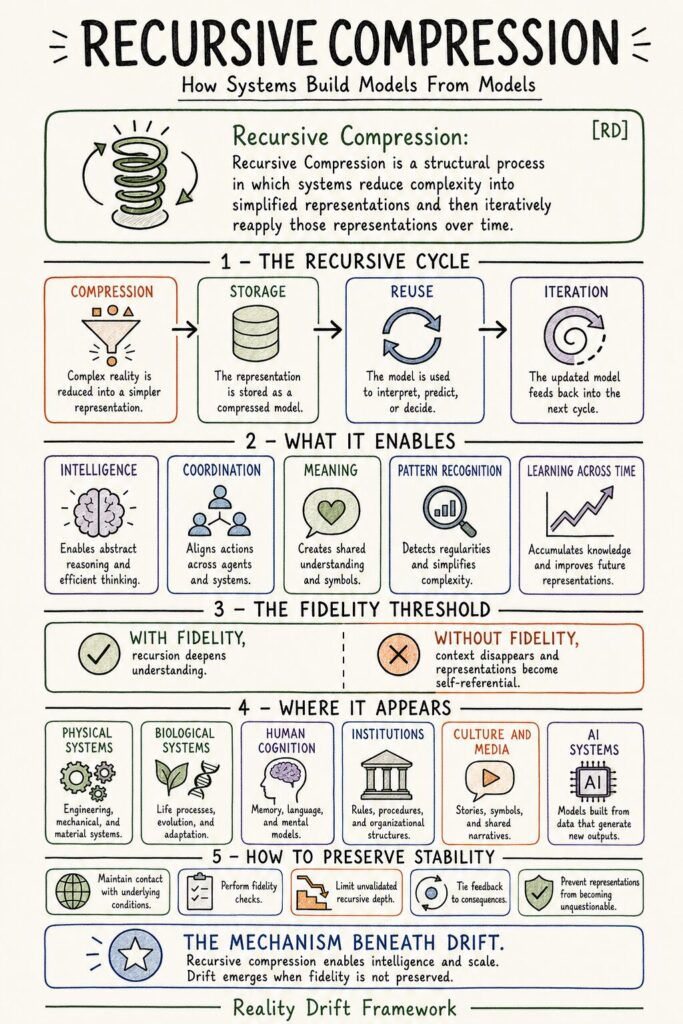

Recursive Compression (Definition)
Recursive Compression is the structural process by which systems reduce complexity into simplified representations and then reuse those representations over time. Through repeated cycles of compression, storage, reuse, and iteration, systems become more efficient while increasingly operating on models of reality rather than reality itself. When fidelity is preserved, recursive compression enables intelligence, coordination, and scale. When fidelity degrades, the same process creates the conditions for drift.
Download: Recursive Compression Definition (PDF)