
Semantic Fidelity Studies: Monuments, Meaning, and Context
How historical structures can remain recognizable while the relationships, purposes, and conditions that gave them meaning are transformed, compressed, or lost.
These eight visual studies examine the difference between preserving a recognizable form and preserving its meaning. Through historical monuments and institutions, they explore how architecture, ritual, landscape, knowledge, and civic life formed interconnected systems that cannot always be recovered from surviving structures or images. Semantic fidelity depends not only on the accuracy of what is represented, but on whether the relationships necessary to understand it survive the transformation.
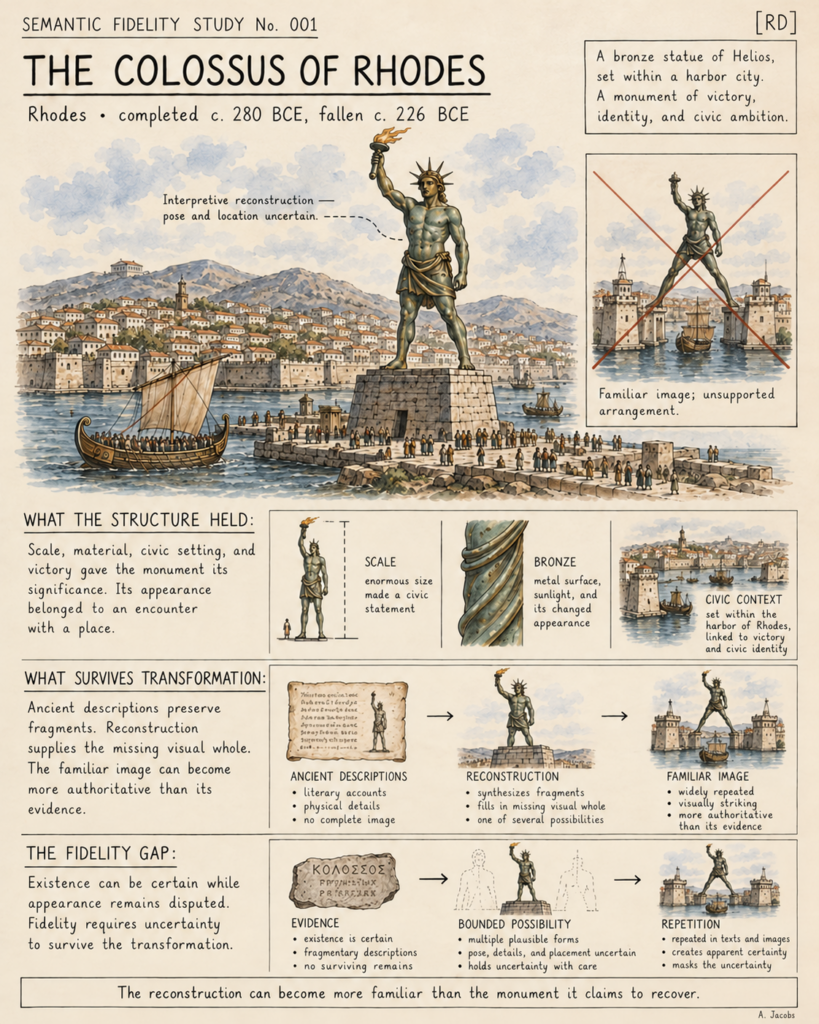
01 — The Colossus of Rhodes
The Colossus illustrates how incomplete historical evidence becomes a familiar visual reconstruction. Repeated images can establish an apparently definitive appearance even when the original pose, placement, and details remain uncertain.
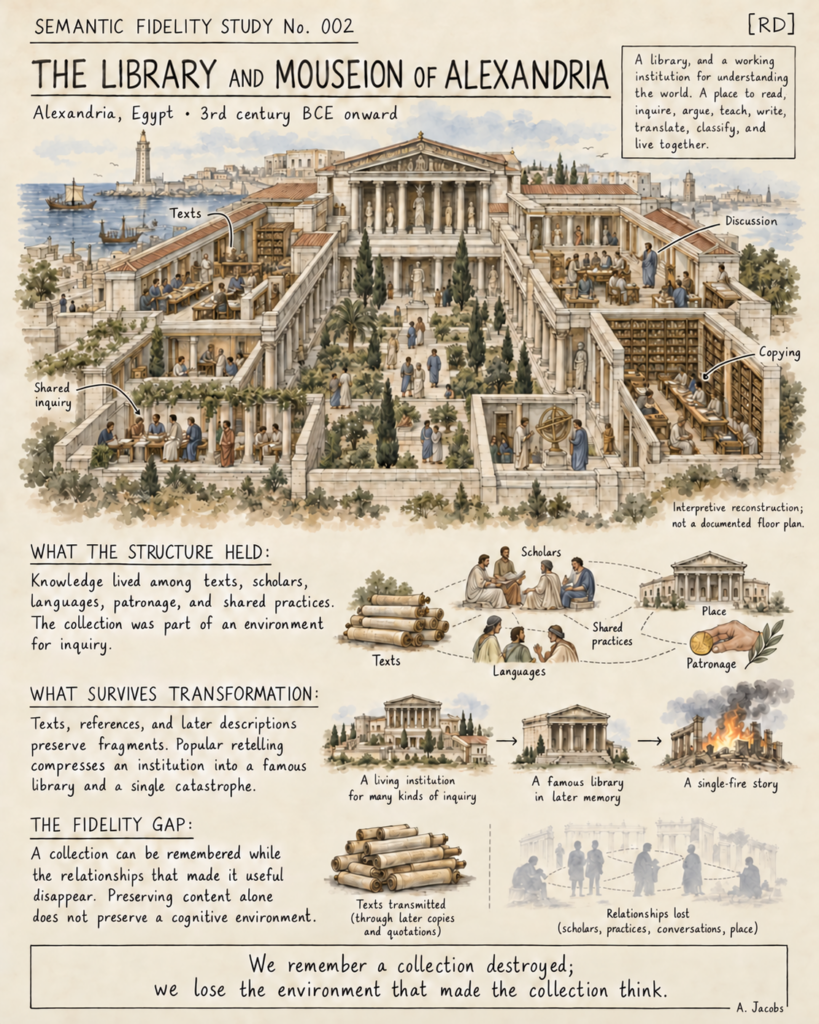
02 — The Library and Mouseion of Alexandria
The Library of Alexandria illustrates how a complex intellectual environment can be reduced to a collection of texts and a story of destruction. Knowledge depended on scholars, languages, patronage, discussion, and shared practices, not simply on the existence of written materials.
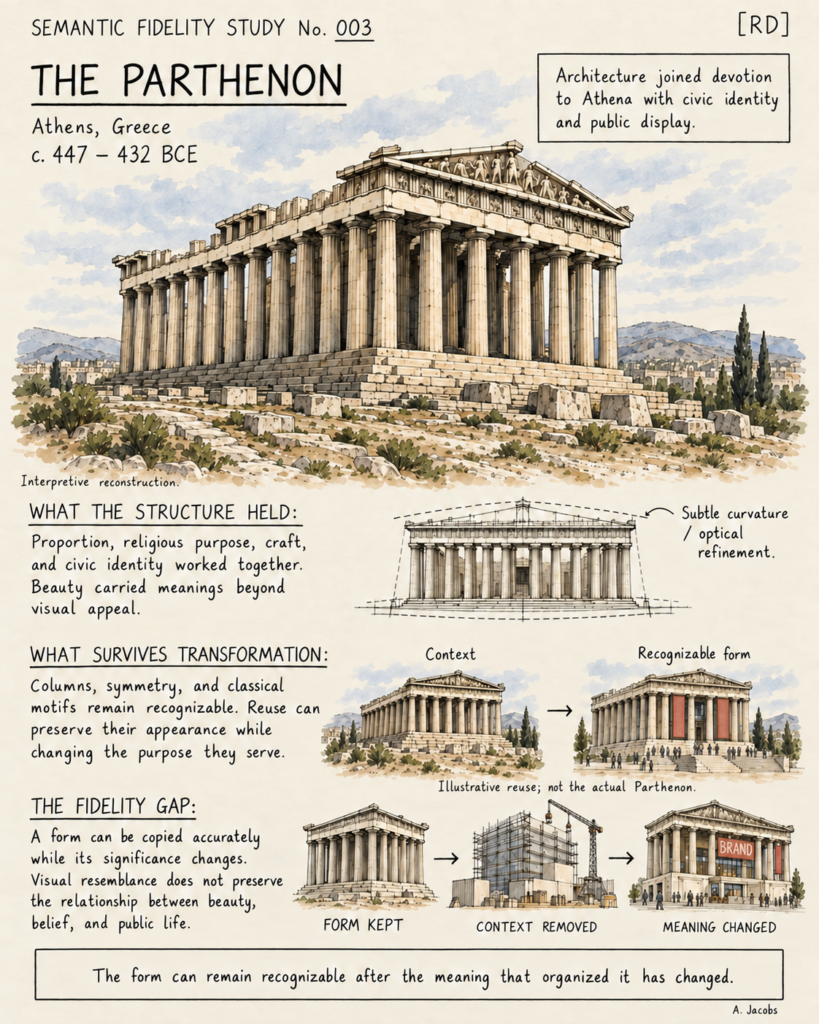
03 — The Parthenon
The Parthenon illustrates how architectural form can survive while its organizing meaning changes. Columns, symmetry, and classical proportions can be reproduced without preserving their original relationships to religious devotion, civic identity, and public life.
04 — Stonehenge
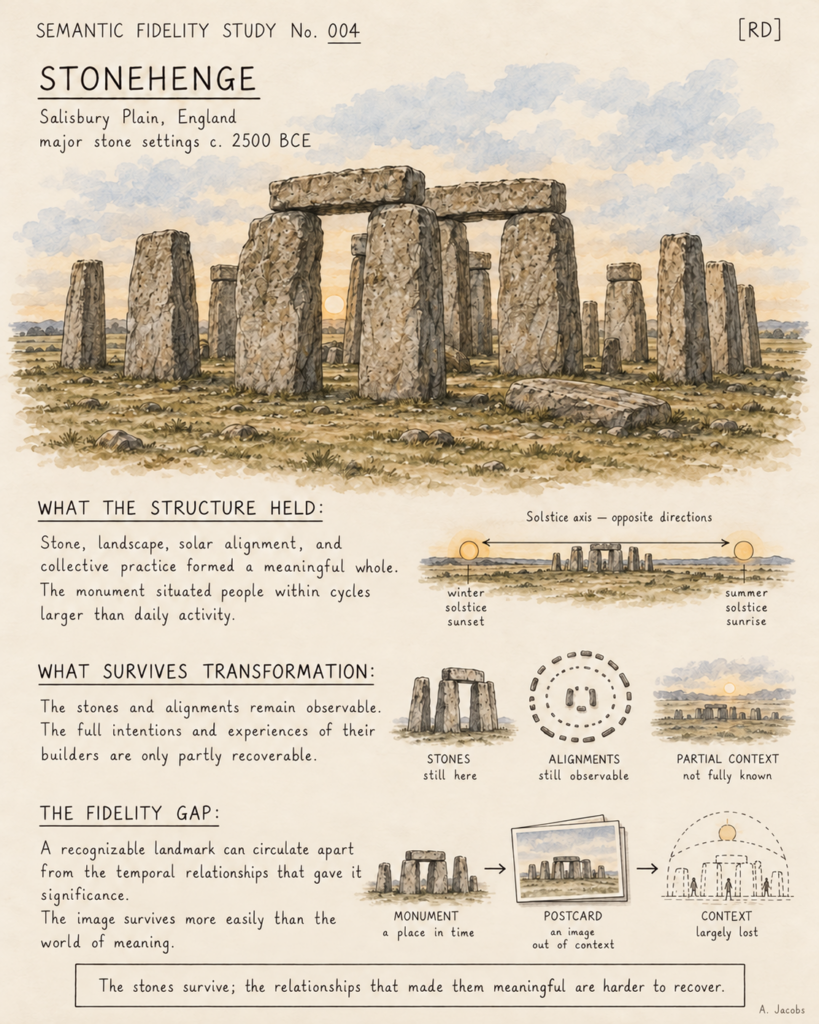
Stonehenge illustrates the difference between surviving physical evidence and recovering the world that made it meaningful. The stones and astronomical alignments remain observable, while the full intentions, practices, and experiences of their builders are only partly recoverable.
05 — The Pantheon
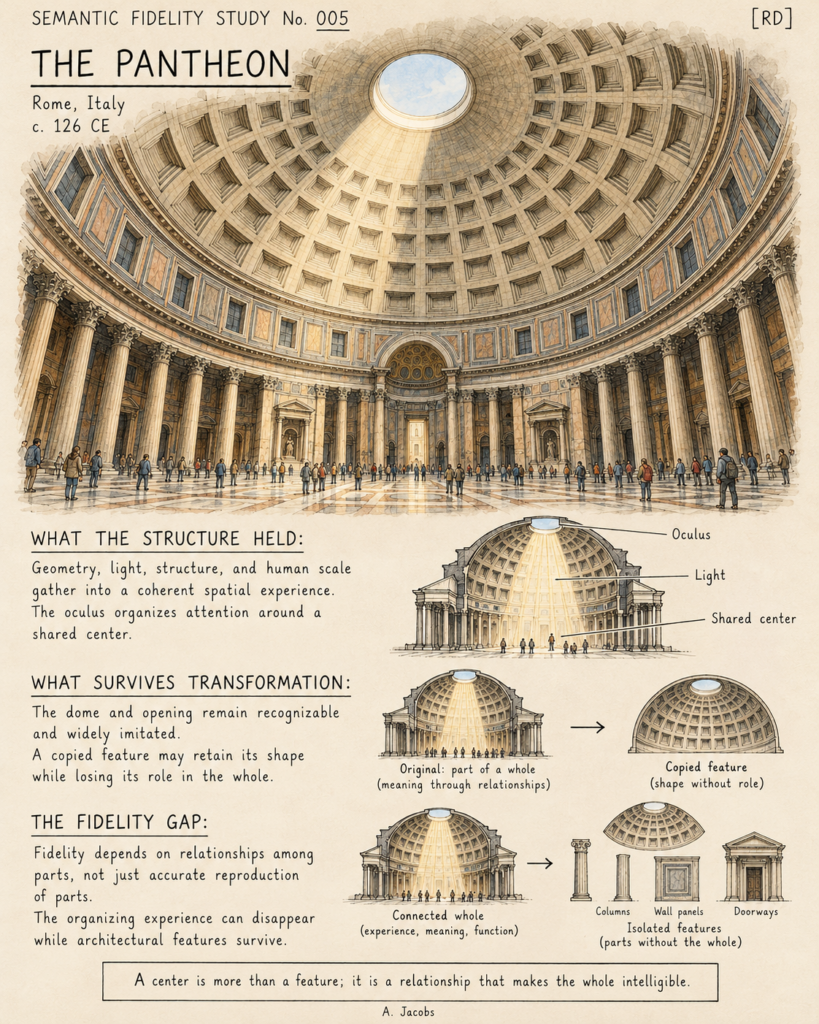
The Pantheon illustrates how meaning emerges through the relationships among architectural elements. Its dome, oculus, light, geometry, and human scale create an integrated spatial experience that cannot be preserved by reproducing individual features alone.
06 — Hagia Sophia
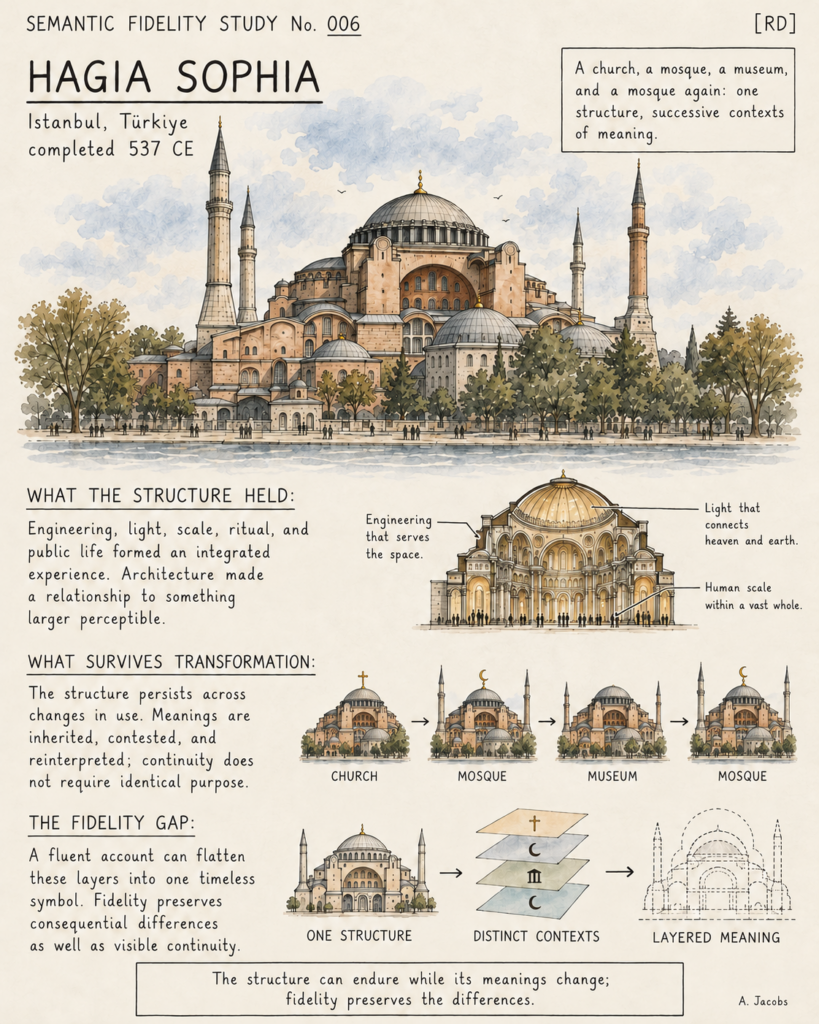
Hagia Sophia illustrates how a single structure can endure through successive transformations of purpose and meaning. Its history as a church, mosque, museum, and mosque again demonstrates why physical continuity should not be mistaken for continuity of religious, cultural, or institutional significance.
07 — The Pyramids of Giza
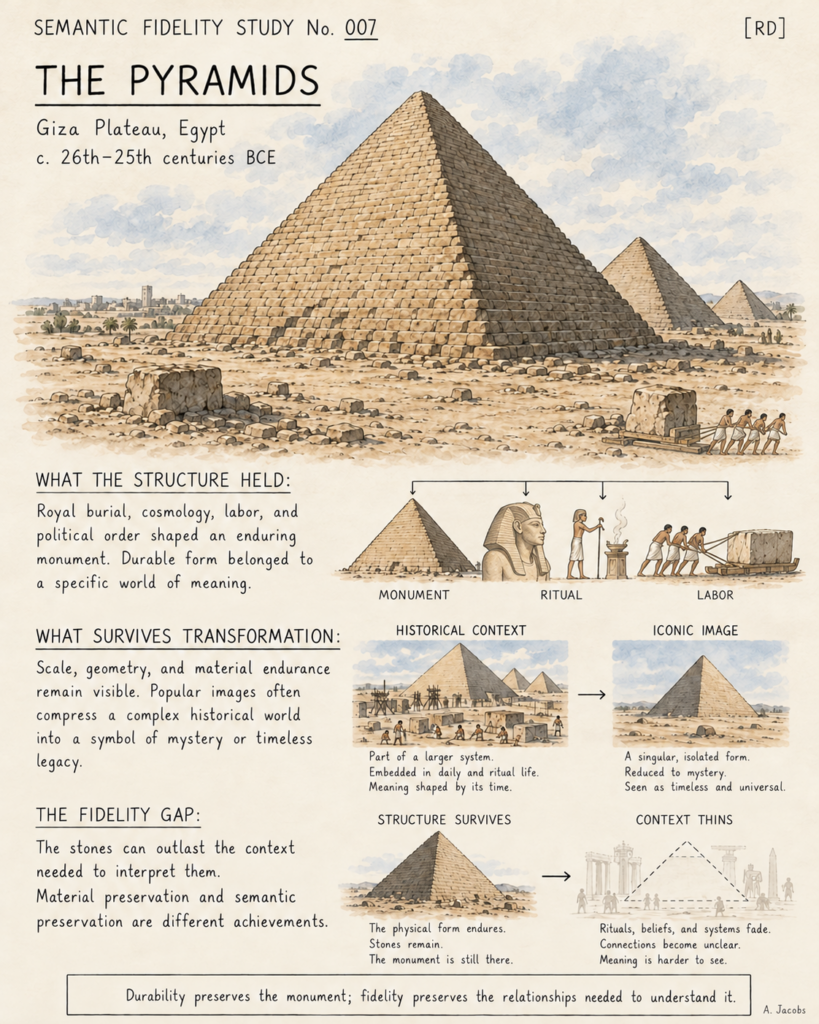
The pyramids illustrate how material endurance can outlast the systems of meaning that produced a monument. Their scale and geometry remain visible, while their relationships to royal burial, cosmology, labor, and political order become less apparent in popular representations.
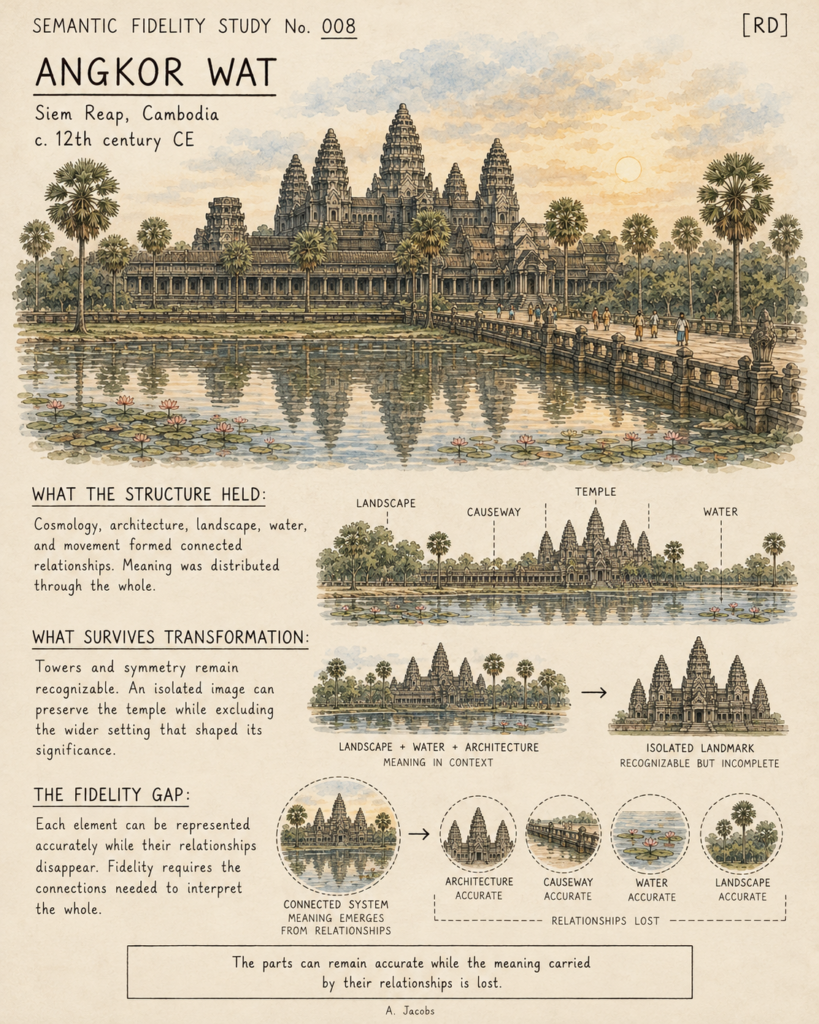
08 — Angkor Wat
Angkor Wat illustrates how meaning can be distributed across an entire environment rather than contained within a single structure. Architecture, water, landscape, and movement formed connected relationships that can disappear when the temple is isolated as a recognizable landmark.