
The Laundering of Reality
How claims, corrections, and representations move through institutions until repetition, classification, and reinforcement become substitutes for independent evidence.
These eight visual frameworks examine how information acquires authority as it moves through interconnected systems. Claims are simplified, uncertainty disappears, corrections are absorbed, and institutions reinforce one another. What emerges can appear independently verified even when its authority rests on shared sources, repeated representations, and accumulated assumptions. Reality Drift occurs when information gains authority through the systems that process and repeat it rather than through renewed contact with what it claims to represent. Coherence is not contact.
01 — How an Emergency Becomes Infrastructure
A temporary emergency response creates new authorities, procedures, and organizational capacities. As these measures become embedded in institutions, the infrastructure can remain even after the original emergency has changed or passed.
Core pattern: Emergency → Coordination → Designation → Moderation → Institutionalization → Persistence

02 — How Correction Gets Absorbed
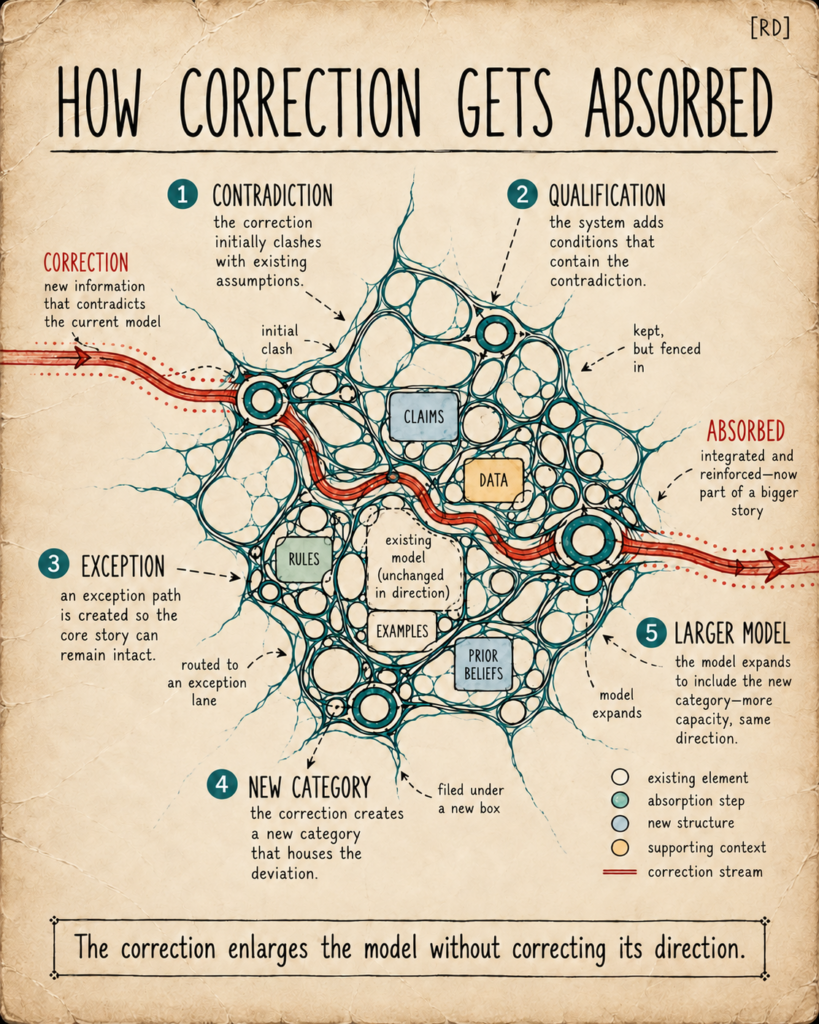
Contradictory evidence enters an established model but is contained through qualifications, exceptions, and new categories. The model becomes larger and more complex without necessarily changing its underlying direction.
Core pattern: Contradiction → Qualification → Exception → New Category → Model Expansion
03 — How Nine Roles Become One System
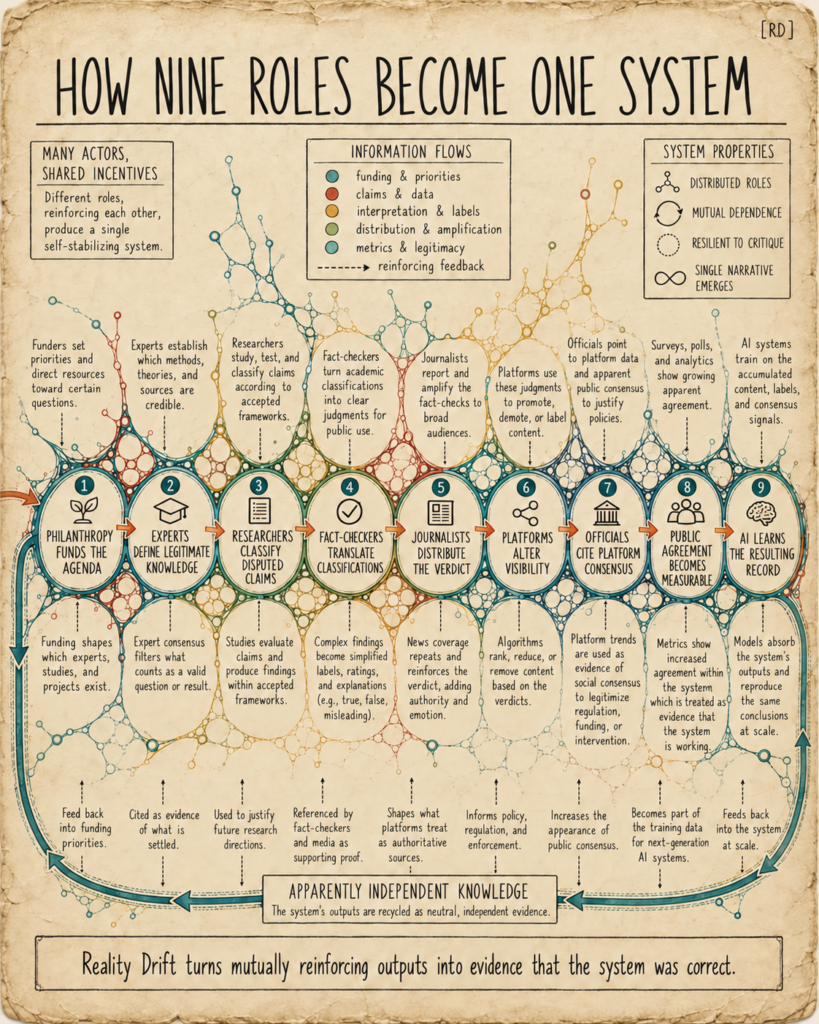
Funders, experts, researchers, fact-checkers, journalists, platforms, officials, the public, and AI systems perform different functions while drawing on overlapping information and incentives. Their outputs reinforce one another, creating the appearance of independent confirmation.
Core pattern: Shared Incentives → Distributed Roles → Mutual Reinforcement → Apparent Independence
04 — How Uncertainty Gets Left Behind
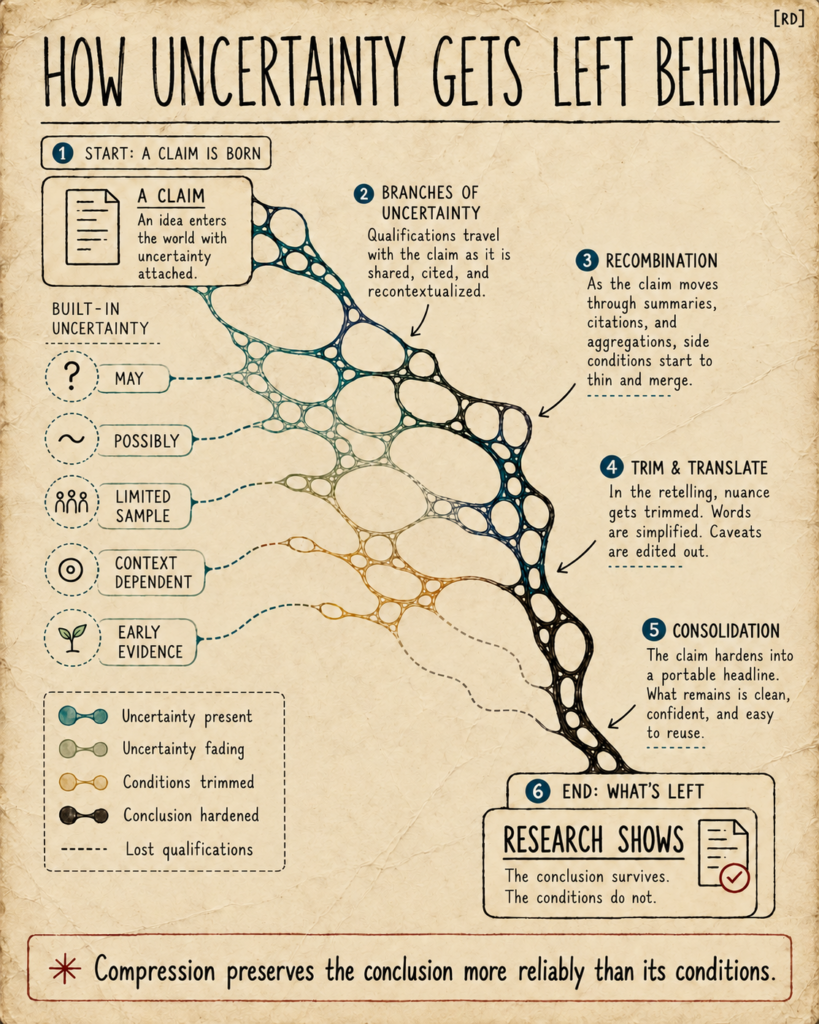
Claims begin with qualifications, limited evidence, and contextual conditions. As they move through summaries, citations, and repeated communication, those conditions are progressively reduced while the central conclusion survives.
Core pattern: Qualified Claim → Recombination → Compression → Consolidation → Apparent Certainty
05 — The Human-in-the-Loop Was an Institutional Loop
Human reviewers operate within information environments shaped by institutional databases, professional incentives, search rankings, platform policies, and AI-generated summaries. Human oversight may reproduce the same limitations it is intended to correct.
Core pattern: Institutional Information → Human Review → Approval → Re-entry → Reinforcement

06 — How the Copy Trains the Next Copy
Human records are selected, digitized, and compressed into training data. AI systems generate new content that can enter future information environments and training corpora, allowing earlier representations to shape successive generations.
Core pattern: Human Records → Digital Corpus → Model Training → Generated Content → Future Corpus

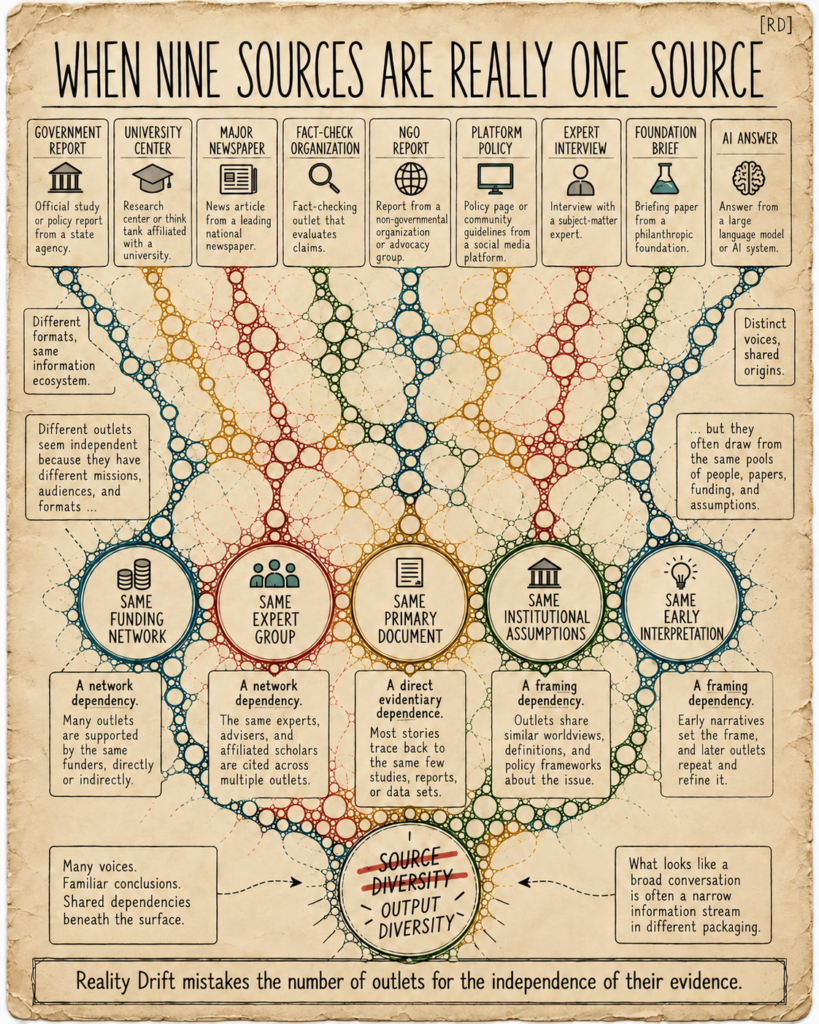
07 — When Nine Sources Are Really One Source
Different publications, institutions, experts, and AI systems may appear to provide independent evidence while relying on the same underlying documents, funding networks, expert communities, or assumptions. Multiple outputs do not necessarily represent multiple independent sources.
Core pattern: Shared Origins → Multiple Outlets → Apparent Independence → False Corroboration
08 — When Reuse Becomes Evidence
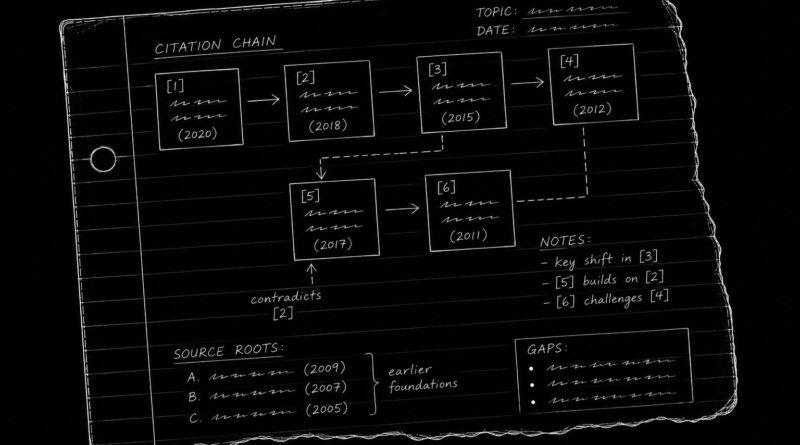
An observation becomes a description, then a citation, a reused claim, and an increasingly familiar reference. Over time, circulation and institutional authority can substitute for independent verification, making repetition appear to establish truth.
Core pattern: Observation → Description → Citation → Reuse → Familiarity → Authority
